
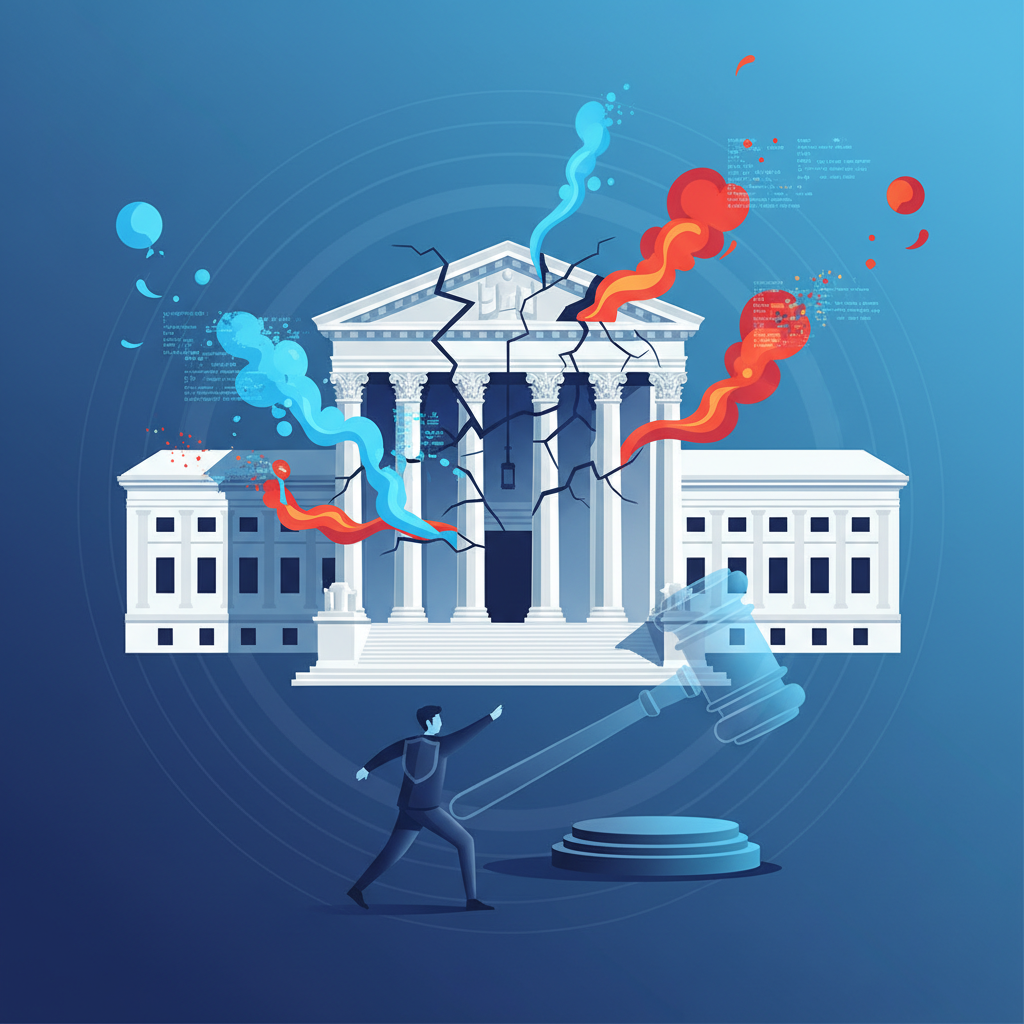
Supreme Court Faces New Leak Crisis as Roberts Urged to Act
Breaking Down Institutional Trust
The Supreme Court faces another damaging breach of confidentiality as internal memos about the controversial “shadow docket” have leaked to the public, according to reports. This latest incident marks the second major leak in recent years, following the unprecedented disclosure of the draft Dobbs decision that overturned Roe v. Wade.
Legal scholar Jonathan Turley has seized on this pattern of breaches to argue that Chief Justice John Roberts must take decisive action to protect the institution’s credibility. Drawing from baseball legend Ted Williams’ approach to the game, Turley suggests Roberts needs to “protect the plate” by bringing in the FBI to conduct a thorough investigation.
A Pattern of Failed Accountability
The current crisis extends beyond mere document leaks. According to reports, the Supreme Court has witnessed public incidents of justices attacking each other, signaling a breakdown in the institution’s traditional culture of confidentiality and civility. This erosion of internal norms comes at a particularly vulnerable moment when public trust in elite institutions across American society remains fragile.
The Court’s internal accountability mechanisms appear insufficient to address these breaches. The failed investigation into the Dobbs leak serves as a stark reminder that traditional approaches to maintaining institutional discipline may no longer be adequate in today’s polarized environment.
The Shadow Docket Controversy
The latest leak centers on internal communications regarding the Court’s “shadow docket” – a system for handling emergency applications and other matters without full briefing or oral argument. Critics have long argued this process lacks transparency and allows the Court to make significant policy decisions with minimal public scrutiny.
By leaking internal memos about these deliberations, someone within the Court’s inner circle has weaponized confidential information for what appears to be partisan purposes. This tactical use of privileged information represents a fundamental violation of the institution’s foundational principles.
Institutional Credibility at Stake
The repeated breaches raise serious questions about the Supreme Court’s ability to function as an impartial arbiter of constitutional disputes. When internal deliberations become fodder for public political battles, the Court risks losing its unique position above the partisan fray that gives its decisions moral and legal authority.
Reports indicate that partisan divisions within the Court have begun to corrode the institutional norms that traditionally maintained collegiality even amid sharp ideological disagreements. The public nature of these conflicts undermines the Court’s carefully cultivated image as a deliberative body focused on legal reasoning rather than political outcomes.
The Case for Federal Investigation
Turley’s call for FBI involvement reflects growing recognition that internal remedies have proven inadequate. The comparison to Ted Williams’ batting philosophy suggests that effective institutional leadership requires protecting core institutional values with the same intensity that the baseball great protected home plate.
This approach would mark a significant escalation in the Court’s response to internal breaches. Previous efforts to identify leakers through internal investigation channels have yielded no results, leaving the institution vulnerable to continued violations of confidentiality.
Broader Implications
The Supreme Court’s leak crisis mirrors broader challenges facing American institutions in an era of intense polarization. When elite institutions lose internal cohesion, they struggle to maintain public legitimacy and effectiveness in their constitutional roles.
The tension between institutional secrecy and public transparency has become particularly acute in recent years. While democratic accountability requires some level of public oversight, the deliberative process depends on participants’ ability to express views candidly without fear of premature disclosure.
Looking Forward
Chief Justice Roberts now faces a critical test of institutional leadership. His response to this latest breach will likely determine whether the Supreme Court can restore the culture of confidentiality essential to its constitutional function or whether it will continue to see its internal deliberations treated as political ammunition.
The stakes extend far beyond the Court itself. In a democratic system that depends on institutional credibility, the Supreme Court’s ability to maintain public trust directly affects its capacity to serve as the final arbiter of constitutional disputes. Without swift action to address the leak problem, the Court risks permanent damage to its institutional standing and effectiveness.